Powering the Digital Backbone: The Role of Natural Gas in Data Center Reliability
Executive Summary
Data centers support many of the digital services used across the economy, and their electricity demand is rising. DOE has reported that U.S. data center load growth has tripled over the past decade and is projected to double or triple again by 2028; LBNL’s 2024 Data Center Energy Usage Report also estimated that data centers consumed about 4.4% of total U.S. electricity in 2023 and could account for about 6.7% to 12% by 2028, depending on scenario assumptions. Global estimates similarly indicate that data center electricity use is already significant and may continue rising as AI expands.
Natural gas can be part of data center power strategies in several ways, including grid generation, standby power, behind-the-meter systems, and some microgrid applications, depending on site design and local infrastructure. For operators and developers, the key issue is not whether a single technology solves the problem, but how the full power chain is engineered to meet an uptime target.
The Digital Economy’s Growing Power Requirement
Many digital services depend on highly available facilities, including AI workloads, cloud platforms, streaming, cybersecurity, financial systems, healthcare applications, and industrial automation. DOE and EIA both indicate that data center electricity demand is rising quickly, and EIA’s recent analysis projects strong growth in data center server electricity use across multiple scenarios.
Because forecasts vary, it is more precise to describe these figures as estimates or scenario-based projections rather than fixed outcomes. The main trend is that large data center loads are becoming a more significant factor in utility planning, transmission planning, and interconnection discussions.
Why Data Centers Cannot Afford Downtime
Data centers are designed for high availability, often using UPS systems, redundant power paths, and standby generation. Common architectures include N+1 and 2N redundancy, but the right design depends on service level, location, and business risk tolerance.
Uptime Institute’s outage research shows that power-related failures remain a major concern in the sector, and that a meaningful share of reported outages carry high financial cost. The operational issue is not just whether a generator exists, but whether the entire system can respond reliably during a fault or utility interruption.
Where Natural Gas Fits Into Data Center Energy Strategy
Natural gas can support data centers in several ways. It is already a major contributor to grid electricity in the United States, it can provide fast-ramping generation for balancing and peak needs, and it can serve as fuel for on-site generation, standby systems, some fuel-cell deployments, and select CHP applications.
Each use case has different requirements. Utility-scale gas generation is not the same as behind-the-meter generation, and prime power is not the same as standby power, so these categories should be described separately.
Backup Power: Diesel, Natural Gas, Batteries, and Hybrid Systems
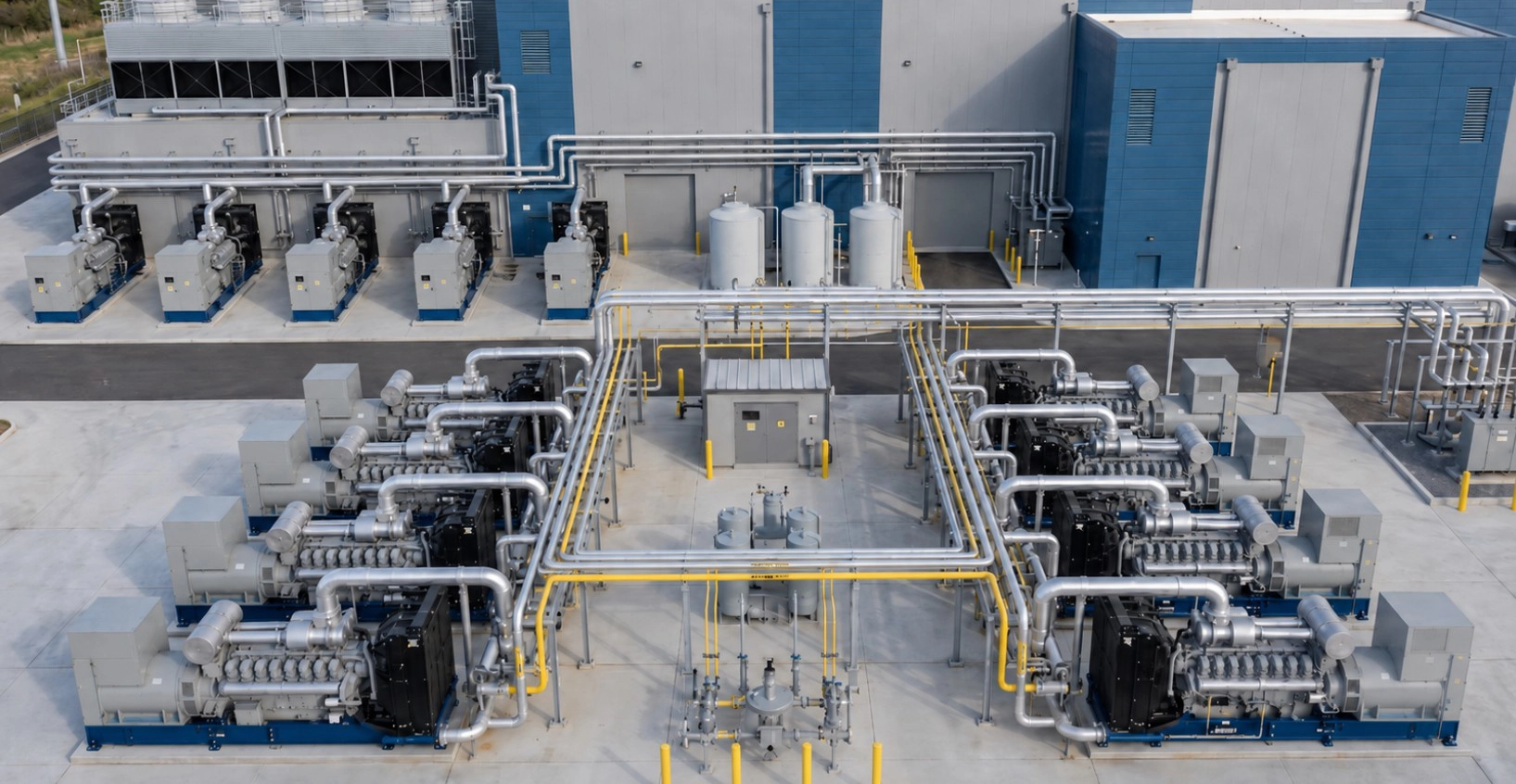
Diesel generators still dominate emergency systems because they are well understood and provide a long runtime with on-site stored fuel. Natural gas generators avoid large liquid-fuel storage and are gaining ground in prime, continuous, and business-continuity roles. The challenge is they depend on firm gas supply, pressure control, and fuel conditioning and they face more scrutiny where the load is life-safety or emergency-rated.
Battery systems provide instant ride-through and are valuable in hybrid architectures, but they usually do not replace long-duration generation on their own. Fuel cells, including natural-gas-fed solid-oxide units, are already in commercial service at some data centers as modular behind-the-meter resources, though economics and fuel-quality requirements vary significantly by site.
Why Fuel Quality and Gas Conditioning Matter
Natural gas-fired equipment is sensitive to fuel quality, and the contaminants of concern depend on both the source and the downstream equipment. Liquids, particulate matter, aerosols, compressor-oil carryover, and moisture can damage regulators, meters, engines, turbines, and fuel cells. Sulfur compounds, including residual H₂S and the mercaptans used for odorization, are a particular concern for fuel cells, where even trace sulfur degrades the stack. Where the supply includes renewable natural gas or biogas, siloxanes become relevant as well, since they form abrasive silica deposits on engine and turbine hot sections. For all of these reasons, filtration, separation, and conditioning are part of reliability design rather than optional accessories.
Proper conditioning can help reduce wear, stabilize combustion, and support consistent operation, especially where maintenance windows are limited and uptime expectations are strict.
The Reliability Chain: From Pipeline to Generator
Reliability depends on the full chain, starting with gas transmission and distribution and continuing through inlet separation, pressure regulation, metering, final filtration and conditioning, and the generator, engine, or fuel cell itself. Filtration is not a single step: coarse separation typically sits upstream of the regulator and meter to protect them from liquids and particulate, while a final coalescing stage is placed close to the equipment just downstream of pressure letdown, where Joule-Thomson cooling can condense additional liquids out of the stream. If any one part of that chain is undersized or poorly maintained, the downstream equipment may not perform as intended.
For developers, that means the fuel strategy should be planned alongside utility interconnection, backup architecture, maintenance access, and monitoring.
Environmental and Community Considerations
Data centers can raise concerns about electricity demand, grid congestion, emissions, water use, land use, noise, permitting, and local community impacts. Those concerns are legitimate and vary by region and facility type, which is why energy sourcing decisions are increasingly site-specific.
At the same time, data centers underpin services that are widely used across the economy, so operators must balance reliability requirements with local infrastructure constraints and regulatory expectations.
Emerging Trends
AI is contributing to faster data center buildout and more complicated load-growth forecasts. Utilities are responding with new generation planning, transmission discussions, interconnection reforms, and interest in flexibility, microgrids, batteries, and behind-the-meter generation.
In parallel, some operators are exploring renewable natural gas, hydrogen blending, and lower-carbon fuel strategies where technically and commercially feasible, but those options remain highly site-specific.
Practical Questions Data Center Developers and Operators Should Ask
- What runtime is required during an outage or grid event?
- Is the gas supply firm, interruptible, or backed by dual feeds?
- What pressure, flow, and turndown are required?
- What contaminants are expected in the gas stream?
- What filtration, separation, and drying are needed upstream of critical equipment?
- What redundancy exists in the fuel gas system?
- How will maintenance be performed without taking critical load offline?
- What emissions, noise, and permitting constraints apply locally?
- How does the fuel strategy integrate with UPS, batteries, and utility power?
- What monitoring and alarms will detect fuel or pressure problems early?
Conclusion
Natural gas is one of several tools used in data center power planning and each option involves its own tradeoffs. In many projects, the most important question is how well the fuel and power chain is engineered, conditioned, and maintained to meet the site’s reliability target.
Companies that supply gas filtration, separation, and conditioning equipment can contribute to that reliability by helping protect downstream natural gas systems.
References and Sources
- U.S. Department of Energy, “DOE Releases New Report Evaluating Increase in Electricity Demand from Data Centers”
- U.S. Department of Energy / GovDelivery summary of the 2024 report
- U.S. Energy Information Administration, “Data center server energy use grows across the United States”
- U.S. EIA press release on the 2026 Annual Energy Outlook
- IEA-linked analysis of data center electricity use
- Uptime Institute, “Annual Outage Analysis 2025”
- FERC, market and load-growth materials
- Utility and industry reporting on interconnection and load flexibility
- 2024 LBNL (Lawrence Berkeley National Laboratory) data center energy usage report
Ready to Secure Your Data Center’s Fuel Reliability?
The reliability of your generation system is only as good as the fuel running through it. FilterFab engineers high-performance separation and filtration solutions built to protect your critical infrastructure.
Contact FilterFab Today