
Dry Gas Filter Maintenance: Common Problems and Solutions
An Engineering Guide to Reliability and Cost Efficiency in Natural Gas Filtration Systems
Executive Summary
Dry gas filters play a critical role in maintaining gas stream integrity and protecting downstream assets such as compressors, turbines, metering stations, and cryogenic exchangers. Despite their simplicity, improper maintenance, poor installation practices, and incorrect operating conditions often lead to performance degradation, premature element failure, and costly unplanned shutdowns.
This paper provides a detailed analysis of common maintenance challenges in dry gas filtration systems—such as premature plugging, media collapse, and bypass—and outlines field-proven troubleshooting methods and preventive maintenance procedures based on industry-recognized codes and standards, including ASME Section VIII and leading OEM standards for filter design and maintenance.
Why Dry Gas Filtration Is Critical
Dry gas filters are precision-engineered vessels designed to remove solid particulates (e.g., rust, black powder, mill scale, silica dust) from high-pressure natural gas streams before they reach sensitive process equipment.
By maintaining particulate concentration below the allowable limit—typically < 1 mg/m³ or a specific ISO particle count rating per ISO 8573-1 — these filters prevent erosion, fouling, and mechanical failure in downstream components.
Key benefits include:
- Compressor and turbine protection – prevents erosion and seal wear.
- Reduced maintenance frequency – minimizes valve and orifice fouling.
- Improved process reliability – ensures stable gas flow and pressure profiles.
In gas processing, dry gas filtration is typically employed upstream of coalescing filters or LNG pre-treatment modules, where clean gas is essential for equipment reliability.
The Role of Differential Pressure (ΔP) in Maintenance
Monitoring differential pressure (ΔP) across filter elements is the most accurate method for evaluating filter performance and determining change-out intervals. Industry practice supports daily logging for manual systems or continuous monitoring via a DCS/SCADA system.
- Normal operating ΔP: Typically 0.3–0.5 bar (4-7psid) for clean elements.
- Recommended maximum ΔP before replacement: 1.0–1.5 bar (15–22 psid), depending on OEM specifications and the required downstream gas quality. [Source: Pall Corporation – Natural Gas Filtration Technical Manual]
A rising ΔP indicates particulate accumulation on the media surface. A sudden or erratic increase may signal filter media collapse, liquid carryover, or plugging from upstream contamination.
Key Maintenance Action:
Operators should log ΔP daily or integrate differential transmitters with the plant DCS to enable predictive maintenance analytics.
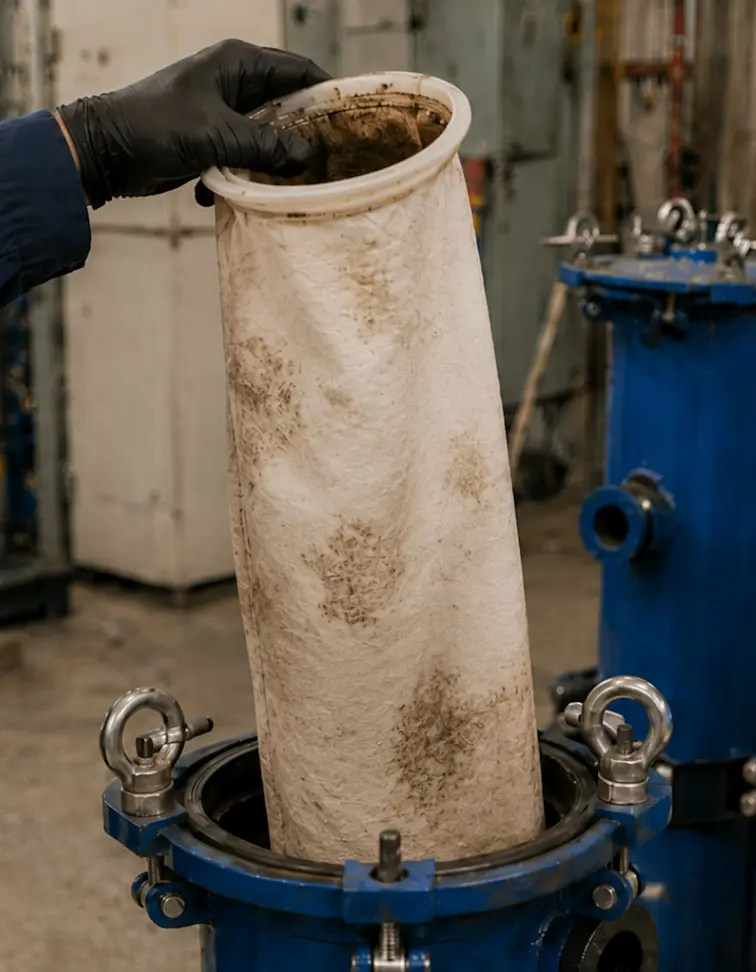
Common Dry Gas Filter Problems
- Premature Plugging of Filter Elements
- Excessive particulate loading from upstream pipeline scale or construction debris.
- Inadequate upstream separation (e.g., slug catchers or vane separators not performing).
- Incorrect filter element rating (micron size too small for upstream conditions or unexpected fine particulate load).
- Element Collapse or Media Damage
- Exceeding vessel design pressure (unlikely unless vessel is severely undersized) or sudden reverse flow during blowdown.
- Liquid slugging entering a dry gas vessel (often caused by inadequate upstream liquid handling).
- Poor quality aftermarket elements lacking structural support cores.
- Bypass Leakage
- Damaged or improperly seated O-rings or gaskets.
- Incorrect installation of element seals or end caps (common during maintenance).
- Vessel lid misalignment or improper torquing of closure bolts.
- Corrosion and Internal Contamination
- Condensation from wet gas streams or residual liquid left after maintenance.
- Inadequate corrosion protection (uncoated carbon steel).
- Prolonged exposure to acidic contaminants (H₂S, CO₂).
- Drain System Malfunction
- Blocked drain valves.
- Faulty level control or condensate traps.
- No routine manual drainage.
[Source: CECO Peerless – Gas Filter-Separator Operations Manual]
Symptoms: Rapid ΔP increase, reduced gas throughput, unplanned shutdowns.
Root Causes:
[Source: Parker Hannifin – Gas Filtration System Design Guide]
Symptoms: Sudden ΔP drop, downstream contamination, evidence of torn or compressed cartridges (loss of element integrity).
Root Causes:
Symptoms: Downstream solids detected despite normal ΔP.
Root Causes:
Symptoms: Rust flakes in filter housing, decreased filter life, leaks at weld joints.
Root Causes:
Symptoms: Accumulation of liquid in the sump, increased ΔP, flooding of filter elements.
Root Causes:
Troubleshooting and Solutions
| Problem | Diagnostic Method | Corrective Action | Preventive Strategy |
|---|---|---|---|
| Premature Plugging | Check $\Delta P$ trend, analyze particulate composition | Install upstream pigging, upgrade pre-filter micron rating | Add pipeline scraper runs quarterly; install upstream separator |
| Element Collapse | Inspect post-changeout; verify design pressure and flow direction | Replace with OEM-rated reinforced elements | Install check valve to prevent backflow during depressurization |
| Bypass Leakage | Perform downstream particle count test | Reseat elements, replace O-rings, torque closure bolts per spec | Implement double-seal design and maintenance sign-off sheet |
| Corrosion | Internal visual inspection, ultrasonic wall thickness test | Recoat or replace housing; upgrade to stainless steel | Use epoxy-coated vessels, implement periodic corrosion inhibitor injection |
| Drain Malfunction | Inspect drain system; test automatic valves | Clean or replace condensate traps | Schedule quarterly functional tests; add redundant manual drain |
[Source: Filter OEM Maintenance Manuals; API 614 and API 12J Operational Guidelines]
Best Practice Maintenance Checklist & Schedule
Daily
- Record ΔP across the filter vessel and compare against the baseline curve.
- Verify drain operation and sump level.
- Observe for audible gas leaks or pressure pulsation.
Weekly
- Inspect inlet/outlet piping for vibration or stress on vessel nozzles.
- Check instrumentation (pressure gauges, DP transmitters) for calibration drift.
Monthly
- Perform visual inspection of vessel exterior for corrosion or paint failure.
- Verify all safety relief valves are sealed and meet ASME VIII requirements.
- Drain and sample collected solids for particle size distribution.
Quarterly
- Open vessel and inspect filter elements if ΔP trend deviates from model.
- Replace all seals, O-rings, and gaskets as standard preventive measures (based on time/cycle).
- Review filter media performance and adjust micron rating if differential pressure rises prematurely.
Annually
- Conduct full internal vessel inspection per API 510 (Pressure Vessel Inspection Code).
- Perform non-destructive examination (NDE) on welds and nozzles.
- Validate housing integrity and pressure relief devices.
[Source: API 510, ASME VIII, and OEM Maintenance Schedules]
Conclusion & Key Takeaway
Dry gas filter reliability depends not only on filter design but also on disciplined maintenance practices. Implementing structured monitoring of ΔP, using OEM-certified elements, and following a rigorous inspection schedule ensures optimal performance and long service life.
Key takeaway:
Unplanned downtime from filtration issues is preventable. Consistent adherence to API 614, ASME VIII, and OEM-specific maintenance protocols can significantly reduce operating costs over the filter’s lifecycle.
[Source: Industry Benchmark Study – Gas Processing Magazine, 2023]
Call to Action
FilterFab provides dry gas filtration systems and custom maintenance programs designed to minimize ΔP drift, extend element life, and reduce unplanned outages. To request a maintenance audit or system performance review, visit FilterFabMFG.com or contact our technical support team.
References and Sources
- API 614 — Lubrication, Shaft-Sealing, and Control Oil Systems for Special-Purpose Applications.
- API 12J — Specification for Oil and Gas Separator Design.
- API 510 — Pressure Vessel Inspection Code.
- ASME Section VIII — Boiler and Pressure Vessel Code.
- Parker Hannifin, Gas Filtration System Design Guide, Technical Publication 2022.
- Pall Corporation, Natural Gas Filtration Technical Manual, 2021.
- CECO Peerless, Gas Filter-Separator Operations Manual, 2020.
- Gas Processing Magazine, “Maintenance Benchmarking Study for Gas Filtration Systems,” 2023.