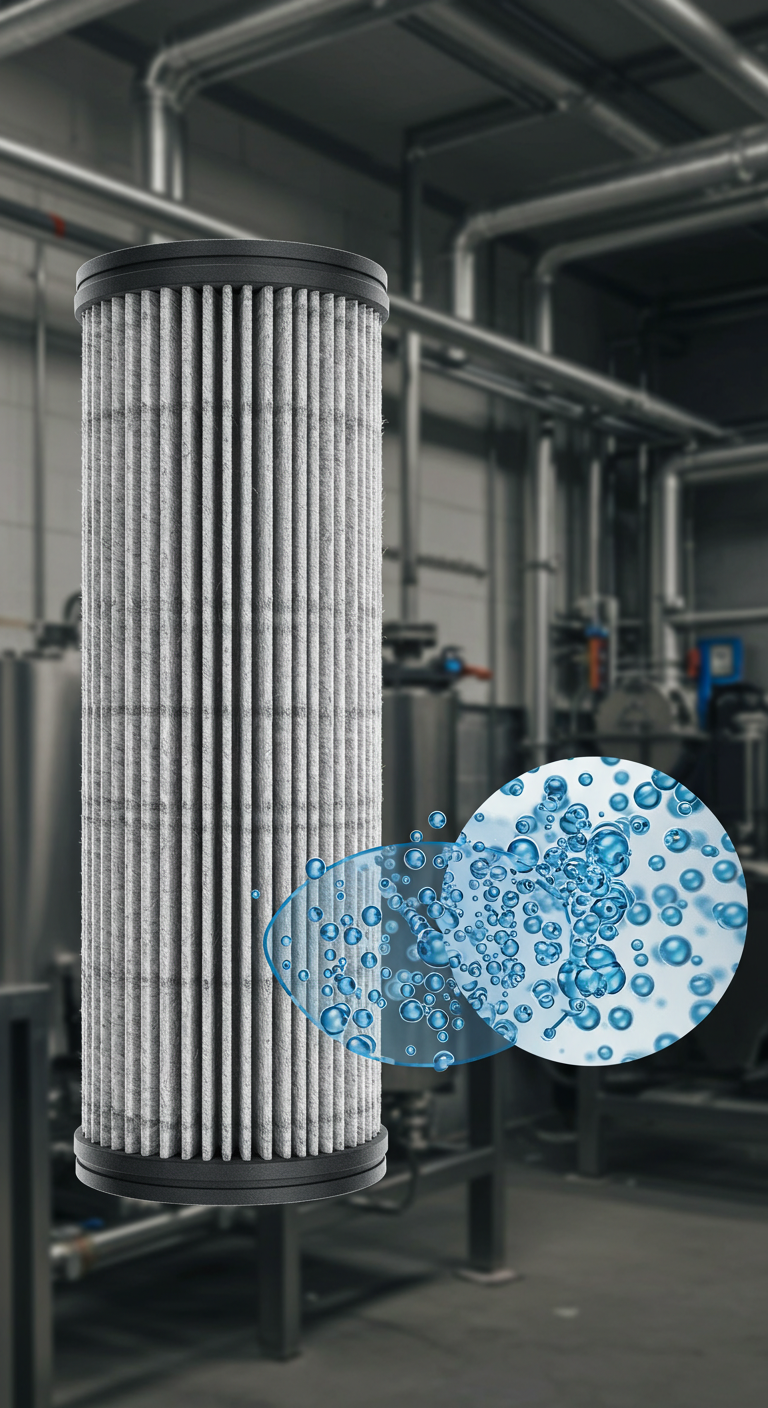
Coalescing Filtration Explained:Removing Liquids and Aerosols from Natural Gas
What Is Coalescing Filtration?
Coalescing filtration is a three-step mechanical process—impingement, coalescence, and drainage—that removes liquid aerosols and fine mists (0.1 µm to 50 µm) from natural gas streams to protect downstream equipment.
Executive Summary
In natural gas systems—spanning upstream gathering, midstream compression, and LNG trains—entrained liquids and fine aerosols pose a significant risk. These contaminants can degrade equipment, pollute process streams, and trigger unscheduled downtime. Coalescing filtration serves as a proven solution to capture and remove these impurities before they reach sensitive downstream components.
Why Liquid & Aerosol Removal Matters
Natural gas is rarely a pure gas; it often carries water, condensate, compressor oil, and aerosols (droplets typically < 10 µm). If not removed, these contaminants cause:
- Erosion & Corrosion: Liquid impingement wears down compressor/turbine blades and pipeline internals.
- Catalyst/Adsorbent Poisoning: Mists foul pre-treatment beds like amines or molecular sieves.
- Metering Issues: Liquid carryover distorts flow and gas quality readings.
- Fouling: Droplets can eventually coalesce into liquid films or "slug flows," reducing system capacity.
How Coalescing Filtration Works
Coalescing is a three-step process where gas passes through a fibrous or pleated medium:
- Impinge and Intercept: Droplets are captured on fiber surfaces.
- Coalesce: Smaller droplets merge into larger ones within the fiber matrix.
- Drain: Gravity or gas drag pulls the enlarged drops into a sump or drain chamber.
This process effectively targets droplet sizes ranging from 0.1 µm to 50 µm.
Technical Design Considerations
Selecting the right coalescer requires balancing several technical factors:
- Efficiency vs. Pressure Drop: Higher capture efficiency often increases the energy/flow penalty (ΔP).
- Wettability: The media's hydrophobic or oleophobic characteristics influence how quickly droplets shed from fibers. Poor drainage can lead to media saturation and "blow-off" (re-entrainment).
- Housing: Units must be rated for specific system pressures/temperatures (e.g., ASME code compliance) and include automatic drains to prevent flooding.
Key Applications
| Application | Purpose |
|---|---|
| Compressor Stations | Protects blades and seals from oil/condensate carry-over. |
| LNG Facilities | Protects cryogenic equipment and ensures gas purity. |
| Pipeline Transmission | Prevents foaming and contamination in amine/molecular sieve systems. |
| Gas Treatment Units | Protects metering equipment from aerosolized condensate. |
Best Practice Checklist for Operators
- Assess Contamination: Quantify liquid rates and droplet size distributions.
- Select Media: Match the media to the specific liquid (water vs. oil) and flow.
- Monitor: Use differential pressure gauges and liquid level indicators for maintenance cues.
- Installation: Ensure proper orientation (vertical/horizontal) and flow direction.
Conclusion
Coalescing filtration is a high-impact, low-risk technology essential for maintaining the reliability and purity of modern natural gas systems.
Technical References & Citations